Workflows
Automating your business processes
Workflows in a Social Care Agency
Workflows in a social care agency are structured sequences of tasks and activities designed to manage and streamline the delivery of care services. They help ensure that care providers follow consistent procedures, maintain compliance with regulations, and deliver quality care. Typical workflows may include:
Client Intake and Assessment: Gathering information about new clients to assess their needs and create personalized care plans.
Care Plan Development: Developing detailed plans that outline the type and frequency of care services required by each client.
Service Delivery: Coordinating and delivering the appropriate care services according to the established care plans.
Monitoring and Evaluation: Regular review and assessment of the client's progress and health status to make necessary adjustments to care plans.
Record Keeping and Documentation: Maintaining accurate and up-to-date documentation of all care activities and client interactions.
Workflows help optimize resource utilization, enhance communication among staff, and improve the overall efficiency and quality of care provided.
Workflow Dashboard
If your agency has subscribed to Workflows, you can access the Workflow functionality from the left menu.
The Workflow Dashboard serves as the central hub for monitoring and managing active business processes within the FieldWorker platform. It provides a real-time tabular view of all ongoing tasks, allowing administrators and supervisors to track progress at a glance.
Key Navigation Tabs
Located at the top of the interface, these tabs allow you to switch between different stages of workflow management:
Workflow Dashboard: The current view, showing active and scheduled workflow instances.
Workflow Library: A repository of pre-defined workflow templates available for use.
Workflow Builder: The interface used to design and customize new workflow structures.
Search and Filtering
To quickly locate specific records, use the filter bar located above the data table:
Select Workflow Type: Filter by status (e.g., Active, Completed, or Archived).
Select Customer: Narrow down results to a specific client.
Select Employee: View workflows assigned to a particular fieldworker.
Search Button: Refines the table based on your selected criteria.

Understanding the Workflow Table
The dashboard displays detailed information for each workflow instance. Key columns include:
Column
Description
Instance ID
A unique numerical identifier for that specific workflow run.
Workflow Title
The name of the process (e.g., "Simple Workflow" or "Node Details WF").
Status
The current state of the process, such as In Progress.
Next Action
The immediate upcoming step required (e.g., "Home Visit").
Start/Ends On
The scheduled timeframe for the entire workflow duration.
Customer/Employee
Identifies the client receiving the service and the staff member assigned.
Created At
The timestamp for when the workflow instance was first initiated.
Action Icons
Edit (Pencil Icon): Located on the far left of each row, this allows you to view or modify the details of a specific workflow instance.
Utility Icons (Top Right): These provide options for changing the table view (List vs. Grid), filtering columns, exporting data, and refreshing the list.
Note: The total count of active workflows is always visible at the bottom right of the page (e.g., Total Rows: 18).
The Active Workflow dashboard displays all workflows that are in 'flight'. More details about any of the 'in-flight' workflows can be seen by opening up the detail window, by clicking the 'edit' icon to the left.
Workflow Instance Journey (Detailed View)
The Workflow Instance Journey is a modal window that appears when you click the Edit (Pencil Icon) on a specific workflow row. It provides a visual and administrative deep-dive into a single active process.
1. Workflow Configuration
On the left pane, you can review and update the core metadata for this specific instance:
Select Workflow: Displays the template being used (e.g., "Simple Workflow").
Select Customer: The client associated with this task.
Select Employee: The fieldworker assigned to execute the workflow.
Date Range: View or adjust the Workflow Start Date and Workflow End Date.
Status Controls: Manually toggle the instance state between Active, Pause, or Close.
2. Visual Journey Map
The center of the screen features an interactive flow chart powered by React Flow, showing the path of the workflow:
Nodes: Represent specific milestones or tasks (e.g., Start, Form Submitted, Home Visit, Task Checked-out, and End).
Color Coding: * Grey: Completed or system steps.
Green: The current Active step.
Orange: Upcoming steps yet to be triggered.
Interaction: You can click on any node or edge to see specific details in the right-hand sidebar.

3. Node Details & Navigation
Detail Sidebar: When a node is selected, its specific properties and data are displayed on the right for review.
Map Tools: Use the
+and-buttons (or your mouse wheel) to zoom in and out of complex workflow maps.
Finalizing Changes
After making any adjustments to the assigned employee, dates, or status, click the Save Workflow Instance button at the bottom of the modal to commit your changes.
Pro Tip: Use the "Pause" button if a fieldworker is temporarily unable to continue a task but you don't want to close the instance entirely.
Workflow Library
All workflows that may have been created by your agency or subscribed to are listed and can be accessed using the Workflow Library tab. The Workflow Library is the management interface where you can view, edit, and control the publication status of your organizational workflows. This screen provides a high-level visual map of the logic and steps contained within a selected process.
Workflow Selection
Use the Select Workflow dropdown menu at the top left to switch between different templates (e.g., Mobile Workflow). This updates the visual canvas to display the specific steps associated with that workflow.
Administrative Actions
Located at the top right, these buttons allow for high-level changes to the template:
Unpublish Workflow: Removes the workflow from active use, preventing new instances from being started until it is published again.
Edit Workflow: Opens the Workflow Builder interface to modify the steps, logic, or triggers of the current template.

Visual Flow Canvas
The main area of the screen displays the sequence of events using a node-based map:
Trigger Nodes (Green): Represent the start of the process (e.g., Start).
Communication Nodes (Orange): Indicate automated outgoing messages, such as Send An Email or Send A Text Message, including a preview of the message content.
Activity Nodes (Blue): Represent field actions or physical tasks, such as a Home Visit.
End Nodes (Red): Mark the formal conclusion of the workflow path.
Logic Edges: The dashed lines connecting nodes illustrate the directional flow and dependencies between steps.
Navigation & Canvas Tools
In the bottom right corner, you will find tools to help manage large or complex maps:
Zoom Controls (+/-): Adjust the scale of the visual map.
Fit to View: Resizes the map to fit all nodes within your current screen.
Mini-Map: A small thumbnail view that allows for quick navigation across a large workflow canvas.
Note: Changes made here affect the global template. To manage individual ongoing tasks, refer to the Workflow Dashboard.
Workflow Editing
All your workflows can be accessed from the dropdown on the top left. Selecting any workflow will open up the workflow for viewing. The workflow can be edited by going to the 'edit' mode.

The 'edit' mode allows you to edit an existing node or edge, change/update, or insert new nodes. The changes made to the workflow can be saved as a new version of the workflow.
Workflow Builder
New workflows can be created from the Workflow builder tab. This tab is usually only available to an admin user. Each workflow can represent an established business flow or a new flow. The Workflow Builder is the administrative workspace used to design new business processes from scratch. While the Library is for viewing templates, the Builder is where the actual logic, steps, and automation rules are constructed.
Getting Started
When you initiate a new workflow in the Builder:
Default Nodes: Every new workflow automatically starts with a Start and End node to establish the boundaries of the process.
Node Palette: All available task types are listed in the left-hand column. To add a step, simply click a node type from this list, and it will appear on your canvas.
Node Types
Node Type
Function
Trigger
Sets the starting condition (e.g., Manual Start or Schedule).
Communication
Sends automated Emails or SMS messages to staff or customers.
Activity
Assigns a physical task to a fieldworker (e.g., Home Visit).
Form
Requires the completion of a specific digital form or assessment.

Building the Logic
Workflows are composed of two primary elements: Nodes and Edges.
1. Node Configuration
Each time you add a node (e.g., a Form, an Email, or a Check-in task), a configuration form appears on the right. Here you define:
Task Details: Specific instructions or labels for the fieldworker.
Requirements: Any data that must be captured (like a signature or a photo) for the node to be considered complete.
2. Defining Edges (Connections)
Edges are the lines that connect nodes, representing the flow of the process.
Creating Connections: Click and drag from the output point of one node to the input of another.
Edge Actions: Once connected, a pop-up allows you to define the Action associated with that transition (e.g., "On Submission," "If Approved," or "After 24 Hours").
Saving and Versioning
Drafting: You can save your progress at any time.
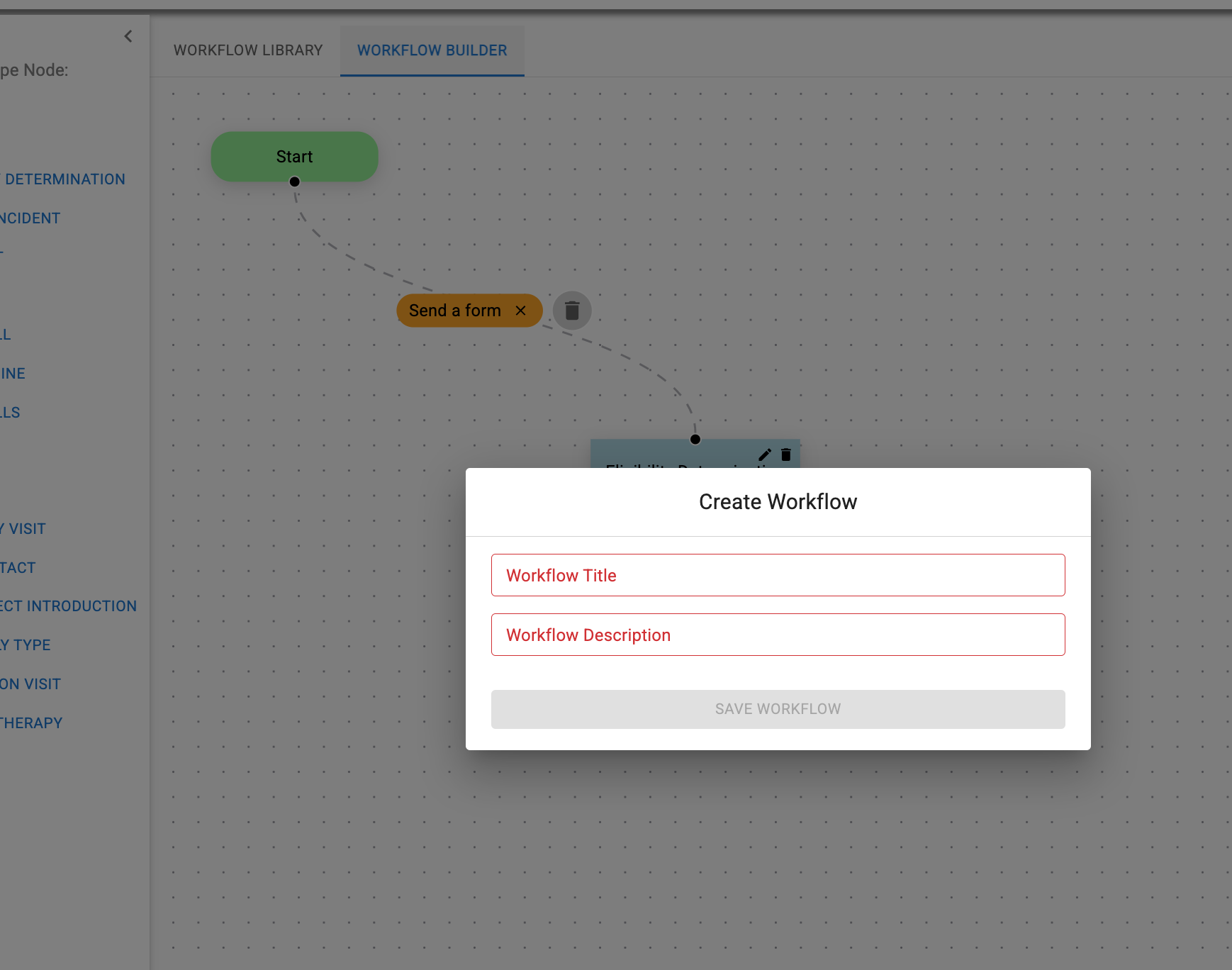
Meta Information: When saving a workflow for the first time, you will be prompted to enter "Meta Information" (Title, Description, etc.), which the system uses to categorize the workflow in the Library.
Versioning: Saving changes to an existing workflow creates a new version, ensuring that currently "in-flight" instances are not disrupted by logic changes.

Nodes in a given workflow are connected by edges. Edges indicate the flow of the process, as the tasks are completed.

The Fieldworker platform allows the edges to perform different actions. Once you connect two nodes, a small pop-up lets you select the action associated with the edge. Depending on the action, you may be asked to add some more details for the edge.
Setting Up Automated Notifications
Automated notifications are a powerful way to keep both fieldworkers and customers informed as a process moves through its stages. In the Workflow Builder, these are handled by specific Communication Nodes.
1. Adding a Notification Node
To include an automated message in your workflow:
Locate the Communication section in the left-hand Node Palette.
Drag either the Send an Email or Send A Text Message node onto your canvas.
Connect an Edge from the preceding task (e.g., a "Form Submitted" node) to this communication node.
2. Configuring the Message
Clicking on a Communication Node opens the configuration panel on the right, where you define the following:
Recipient: Choose whether the message goes to the Assigned Employee, the Customer, or a specific Administrative Email.
Subject/Header: For emails, define the clear purpose of the message.
Message Body: Draft the actual content. You can use dynamic "tags" to automatically insert details like the Customer Name or Appointment Time.
3. Triggering Logic
Notifications only fire when the workflow reaches that specific point in the map. Common triggers include:
Immediate: Sending a "Thank You" text immediately after a home visit is checked out.
Delayed: Sending a reminder email if a required form hasn't been opened within 4 hours (using a conditional edge).
Best Practices for Notifications
Keep it Concise: For SMS, keep messages under 160 characters to ensure they aren't split into multiple texts.
Clear Branding: Ensure emails clearly state they are coming from your agency to avoid being marked as spam.
Test the Flow: Before publishing, use the "Preview" mode to ensure the logic flows into the notification node as expected.
Advanced Logic: Using Conditional Edges
In the Workflow Builder, you can create non-linear processes by using Conditional Logic. This allows the workflow to branch into different paths based on the outcome of a specific task.
1. Creating a Branch
To create a conditional path:
Add a node that requires a decision or outcome (e.g., an Eligibility Determination or a Form).
Draw an Edge (connection line) from that node to the next possible step.
A pop-up will appear, allowing you to define the Action or Condition for that specific path.
2. Common Edge Conditions
You can set different rules for how a fieldworker progresses through the map:
On Approval / Rejection: Direct the workflow to one node if a supervisor approves a form, and a different node if it is rejected.
Data-Driven Logic: Trigger a specific branch if a fieldworker enters a certain value in a form (e.g., if "Client Needs Transport" is checked, the next node assigned is "Vehicle Dispatch").
Time-Based Transitions: Set an edge to trigger automatically if a task is not completed within a specific timeframe (e.g., "If not finished in 24 hours, send Reminder SMS").
3. Managing Multiple Paths
The visual canvas helps you track these complex "If/Then" scenarios:
Parallel Paths: You can have two tasks occur simultaneously by drawing two edges from a single "Start" or "Trigger" node.
Merge Points: Multiple branches can eventually lead back to a single node (like a final "Summary Report") before reaching the End node.
Node Palette Reference
When building your logic, use the left-hand sidebar to drag in these specialized nodes:
Eligibility Determination: Used for intake processes to decide if a client qualifies for services.
Checklist: Ensures a fieldworker completes a series of sub-tasks before the workflow can move to the next node.
Assessment: Specialized nodes for clinical or social evaluations that often trigger conditional branches.
Note: Always ensure every branch eventually leads to an End node. A workflow with a "dead-end" branch cannot be published.
Would you like me to document how to set up the Automated Notifications (Email/SMS) that trigger during these transitions?

Saving and Publishing Workflows
Once you have designed your process in the Workflow Builder, the final step is to save and prepare the template for use. The system uses a versioning and metadata approach to ensure that your workflows remain organized and do not disrupt ongoing field operations. You can also save the workflow when it is complete or at any time, in between. Saving the workflow for the first time will ask you to add meta information to this workflow, which will be used by the Workflow orchestrator when a new workflow instance is instantiated.
1. Saving Your Progress
You can save your workflow at any point during the design process using the controls in the top right corner:
Discard: Reverts all unsaved changes made during the current session.
Save Workflow: Commits your current progress to the system.
2. Adding Meta Information
When you save a workflow for the first time, a "Create Workflow" dialog will appear. You must provide the following details:
Workflow Title: A clear, identifiable name (e.g., "Monthly Safety Assessment").
Description: A brief summary of what the workflow accomplishes.
Status: Choose whether the workflow is Active (available for use) or Inactive (hidden from the library).
Note: This information is used by the Workflow Orchestrator to correctly categorize and trigger instances when a fieldworker starts a task.

3. Versioning Control
The FieldWorker platform automatically handles versioning to protect your data integrity:
Drafting: Changes are saved to the template without affecting any workflows currently "in-flight" in the field.
New Versions: When you make significant logic changes and save, the system creates a new version of the template.
Impact: Existing active instances will continue to follow the old logic, while any new instances started after the save will follow the updated version.
4. Publishing to the Library
Once saved, the workflow appears in the Workflow Library. From there, you can:
Review: See the full visual map of the logic you built.
Unpublish: If a process becomes obsolete, you can "Unpublish" it to prevent staff from starting new instances of that specific workflow.
Last updated