> For the complete documentation index, see [llms.txt](https://fieldworker.gitbook.io/fieldworker-docs/llms.txt). Markdown versions of documentation pages are available by appending `.md` to page URLs; this page is available as [Markdown](https://fieldworker.gitbook.io/fieldworker-docs/fundamentals/pages/scheduler.md).
# Scheduler
All your activities in one place
The [Scheduler](https://dev.fieldworker.ai/scheduler) is the central hub for managing your agency’s appointments, field visits, and staff assignments. It provides a real-time, interactive calendar that ensures your team is synchronized and your clients are covered. The Scheduler page allows everyone in your agency to create and/or manage sessions and events, track attendance, and unit utilization. Online scheduling software for better session management that cuts hours of admin work. For a daycare agency, the scheduler page is the default landing page.
### 📅 1. Navigation and View Controls
The scheduler offers several ways to visualize your data depending on your current needs (e.g., daily dispatching vs. monthly planning).
* Time Navigation: Use the \[Today], \[Back], and \[Next] buttons to move through the calendar.
* View Selectors: Choose your preferred layout at the top right:
* Month: A high-level overview of the entire month’s workload.
* Week/Day: Zoom in for precise hourly scheduling and gap identification.
* Agenda: A list-based view of all upcoming sessions, perfect for quick daily reviews.
* Print: Click \[PRINT] to generate a physical or PDF copy of the current calendar view.
### 👥 2. Filtering and Employee Selection
You can toggle the calendar to show the schedule for the entire agency or narrow it down to a specific individual.
* View Dropdown: Switch between different view types (e.g., "Employee" view).
* Employee Filter: Use the Employee dropdown to select a specific staff member. This is essential for managers to verify an individual’s availability before assigning new tasks.
### ➕ 3. Scheduling a New Session
To add an activity to the calendar:
1. Click the \[SCHEDULE SESSION] button at the top right.
2. In the modal that appears, you will typically define the Customer, Task Type, Date/Time, and Assigned Employee.
3. Once saved, the session will appear on both the web portal and the assigned worker’s mobile app.
### 🖱️ 4. Managing Calendar Entries
Individual entries (such as the "Third one" example on your screen) provide at-a-glance information and quick actions.
* Status Indicators: Colors often represent the status of a session (e.g., Scheduled, In-Progress, or Completed).
* Quick Icons:
* 🔄 Sync: Indicates the session status with the mobile app or billing engine.
* 📝 Edit/Details: Open the session to modify notes or change the time.
* ✖️ Remove: Cancel or delete the scheduled session.
### 💡 Productivity Tips
* Drag-and-Drop: In Week or Day view, you can often click and drag sessions to reschedule them instantly.
* Floating Action Button: The blue icon in the bottom right corner serves as a shortcut for frequently used support or creation tools.
> Changes made here sync immediately. If you update a session time, the assigned fieldworker will see the update in their mobile [Scheduler](https://dev.fieldworker.ai/scheduler) the next time their app refreshes.
### 🚀 How to Create a New Session
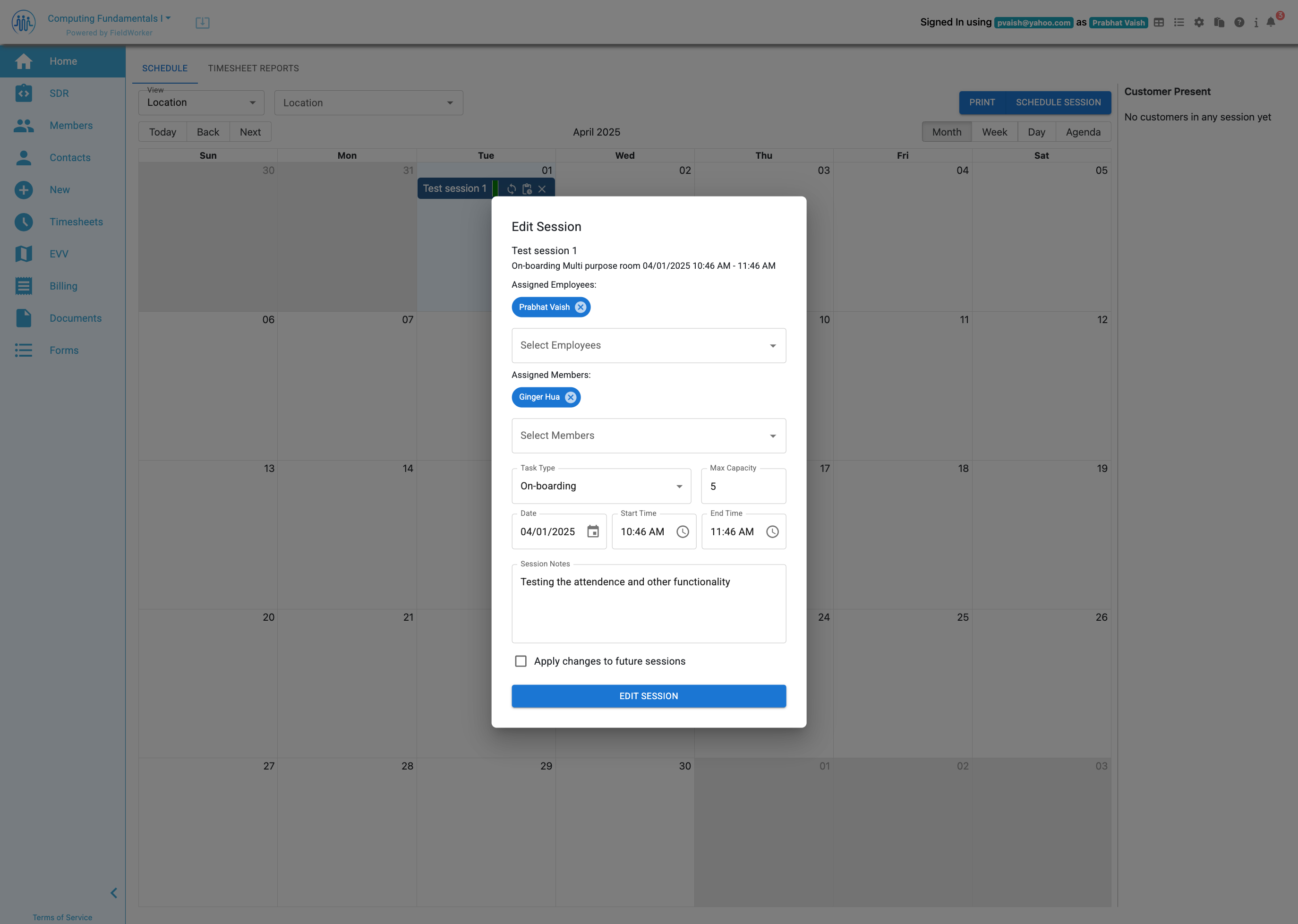
This guide explains how to use the Schedule New Session modal to add activities, visits, or appointments to the [Fieldworker Scheduler](https://dev.fieldworker.ai/scheduler). To open the scheduling interface, navigate to the [Scheduler](https://dev.fieldworker.ai/scheduler) tab on the left-hand sidebar and click the blue [SCHEDULE SESSION](https://dev.fieldworker.ai/scheduler) button at the top right of the page.
#### 1. Basic Details
* Session Name: Enter a clear, descriptive title for the event (e.g., "Monthly Progress Review" or "Initial Intake").
* Location: Select the specific site where the service will occur (e.g., Office, Home, or Telehealth) from the dropdown menu.
* Task Type: Choose the category of work being performed. This is linked to your [Billing Mapping](https://dev.fieldworker.ai/workflows) and dictates which forms will be available to the worker.
#### 2. Assignment & Participants
* Employees: Select the staff member(s) responsible for this session. By default, your own name may be selected, but you can add or swap other team members here.
* Select Members: Choose the Customer(s) or Client(s) who will be receiving the service during this session.
* Max Capacity: If this is a group session, enter the maximum number of participants allowed.
#### 3. Time & Date
* Select Date: Choose the calendar day for the session.
* Start & End Time: Define the exact window for the appointment.
> Ensure these times align with the authorized hours for the client to avoid billing overlaps or rejections.
#### 4. Documentation
* Notes: Add any specific instructions, gate codes, or clinical goals that the fieldworker needs to see before they start the activity.
#### 🛠️ Finalizing the Schedule
Once all fields are complete, click the blue [SCHEDULE SESSION](https://dev.fieldworker.ai/scheduler) button at the bottom of the modal.
* Instant Sync: The session will immediately appear on the web [Scheduler](https://dev.fieldworker.ai/scheduler) and the [Mobile App](https://dev.fieldworker.ai/) of the assigned employee.
* Calendar View: You can verify the entry by switching between the Month, Week, or Day views at the top right of the calendar.
#### 💡 Pro-Tip: Using the Agenda View
If you are scheduling multiple sessions in a row, switch to the [Agenda](https://dev.fieldworker.ai/scheduler) view. This list-style layout makes it easier to spot time gaps in an employee's day, helping you maximize their billable hours without overbooking.
### 🔁 Creating a Recurring Schedule
Recurring sessions are typically managed by enabling the Repeat or Recurrence toggle within the [Schedule New Session](https://dev.fieldworker.ai/scheduler) modal.
#### 1. Enable Recurrence
In the [Schedule New Session](https://dev.fieldworker.ai/scheduler) modal, look for the Repeat toggle (usually located near the Date/Time fields). Switching this to "On" will reveal additional frequency options.
#### 2. Set the Frequency
Choose how often the session should repeat:
* Daily: For services provided every day.
* Weekly: The most common setting for therapy or home visits. You can select specific days (e.g., *Mondays and Wednesdays*).
* Monthly: For once-a-month check-ins or supervision visits.
#### 3. Define the Duration
You must tell the system when the automation should stop:
* End Date: Set a specific date in the future (e.g., the end of the current authorization period).
* After X Occurrences: Set the session to stop after a specific number of visits (e.g., "Repeat for 12 weeks").
#### 🛠️ Managing Recurring Series
Once a recurring series is created, it appears on the [Scheduler](https://dev.fieldworker.ai/scheduler) as individual blocks. However, they remain linked as a "series."
* Editing the Series: If you click on one session in the series and select Edit, the system will ask if you want to change "This Session Only" or "All Future Sessions."
* *Example:* If a client changes their weekly appointment time permanently, choose "All Future Sessions."
* Deleting/Canceling: Similarly, you can cancel a single holiday visit without affecting the rest of the year’s schedule by selecting "This Session Only."
#### ⚠️ Important Considerations
* Conflict Detection: When creating a recurring series, the [Scheduler](https://dev.fieldworker.ai/scheduler) will check for conflicts. If an employee has a one-off doctor's appointment in 3 weeks that overlaps, the system will flag that specific date as a conflict.
* Billing Alignment: Always ensure the end date of your recurring series does not exceed the [Member's](https://dev.fieldworker.ai/customers) insurance authorization end date to prevent "unbillable" sessions from appearing on the calendar.
> Pro-Tip: Use Recurring Sessions for internal meetings, too! You can schedule a "Weekly Team Sync" and assign all your [Employees](https://dev.fieldworker.ai/Settings) at once to keep everyone's [Home](https://dev.fieldworker.ai/) dashboard updated.
The Fieldworker scheduler (or Calendar) allows three separate views, one each for locations, employees, and customers. This allows your agency to generate daily (or weekly, or monthly) schedules for every location(resource), employee, or even customer.
The monthly view lists all activities planned during a calendar month. for one (or more) employees, resources, or customers.
An admin can edit a session to incorporate any changes.
An employee may only edit certain fields.
### An Employee view
Allows an agency to view all sessions that have been assigned to an employee.
### Agenda view
The agenda page presents a tabular view of the sessions assigned to selected customers (employees or resources). The [Agenda](https://app.gitbook.com/o/l66ooAirOIZbkkTyDA8V/s/FKFmA5xK4sMCcp1WP4Kc/~/edit/~/changes/647/fundamentals/pages/scheduler) view is a specialized, tabular layout of the [Scheduler](https://app.gitbook.com/o/l66ooAirOIZbkkTyDA8V/s/FKFmA5xK4sMCcp1WP4Kc/~/edit/~/changes/647/fundamentals/pages/scheduler) designed for high-density information review. Unlike the visual grid of the Day or Week views, the Agenda view prioritizes text-based details, making it the best tool for auditing notes, attendance, and form completion.
#### 📋 1. The Agenda Table Structure
The Agenda view organizes all scheduled sessions into a clean, searchable list.
Column
Description
Date
The calendar day of the session.
Time
The specific start and end window (e.g., 10:46 am – 11:46 am).
Event
Contains the Session Name, a brief Description, and the names of Assigned Members (staff).
#### 🛠️ 2. Integrated Functionality & Icons
Within the Event column, several icons allow you to manage the session directly from the list:
* View/Edit (📋): Open the session to modify internal notes or clinical descriptions.
* Recurrence (🔄): Create recurrence for this session.
* Remove (✖): Cancel or delete the session from the master schedule.
* Attendance Tracking: If your agency tracks attendance, this view allows you to see which clients are "Expected to Attend."
#### 📝 3. Progress Notes and Forms
The Agenda view is unique because it serves as a gateway to clinical documentation:
* Individual Client Notes: You can create specific notes indicating the progress or performance of a client during that specific session slot.
* Form Access: If a [Form](https://app.gitbook.com/o/l66ooAirOIZbkkTyDA8V/s/FKFmA5xK4sMCcp1WP4Kc/~/edit/~/changes/647/fundamentals/pages/forms) (such as a SOAP note or specialized assessment) is linked to the Task Type, employees can access and complete those forms directly through the Agenda interface.
#### 👥 4. "Customer Present" Sidebar
On the right side of the [Agenda](https://app.gitbook.com/o/l66ooAirOIZbkkTyDA8V/s/FKFmA5xK4sMCcp1WP4Kc/~/edit/~/changes/647/fundamentals/pages/scheduler) page, you will find a dedicated panel labeled Customer Present.
* Real-Time Tracking: This panel lists the customers currently checked into a session.
* Oversight: It provides managers with an instant snapshot of which clients are receiving services at any given moment across the entire agency.
#### 💡 Why Use Agenda View?
* For Auditors: It is the easiest way to verify that every session has a corresponding note or form attached.
* For Dispatchers: It allows for a quick "scroll-through" of the day’s workload to ensure no sessions are missing assigned staff.
* For Printing: The tabular format is highly printer-friendly for creating daily manifests using the [PRINT](https://app.gitbook.com/o/l66ooAirOIZbkkTyDA8V/s/FKFmA5xK4sMCcp1WP4Kc/~/edit/~/changes/647/fundamentals/pages/scheduler) button.
> Pro-Tip: If you are looking for a specific session from last month but don't know the exact date, use the Agenda view combined with your browser’s "Find" function (`Ctrl+F` or `Cmd+F`) to search for the session name or employee.
### 👥 How to Mark Attendance
The Attendance modal in the [Scheduler](https://dev.fieldworker.ai/scheduler) is a vital tool for verifying service delivery. It allows administrators and supervisors to manually confirm which members were present during a scheduled session, ensuring that documentation matches actual attendance for billing and compliance.
To access this feature, navigate to the [Scheduler](https://dev.fieldworker.ai/scheduler) and switch to the [Agenda](https://dev.fieldworker.ai/scheduler) view.
1. Locate the Session: Find the specific appointment in the Agenda list.
2. Open Attendance: Click on the Assigned Members link or the attendance icon within the "Event" column. This will launch the Attendance modal.
3. Identify the Member: The modal lists all members assigned to that specific session (e.g., Chris\_Cus V).
4. Record Status: Use the action icons next to the member's name:
* Checkmark Icon (Verify): Click this to mark the member as "Present." This provides a quick validation that the service was successfully delivered.
* Checkmark with Edit Icon (Detailed Attendance): Click this to mark attendance while simultaneously adding specific notes or observations about the member's participation during the session.
#### 🛠️ Why Marking Attendance is Critical
* Audit Readiness: Manually verifying attendance in the web portal creates a secondary layer of proof alongside the fieldworker's mobile check-in.
* Billing Accuracy: Only sessions with confirmed attendance should proceed to the [Billing](https://dev.fieldworker.ai/billing) phase. This prevents claims from being filed for "No-Shows."
* Real-Time Monitoring: The "Customer Present" status on the [Scheduler](https://dev.fieldworker.ai/scheduler) dashboard updates immediately, allowing office staff to see exactly who is currently receiving services across different [Locations](https://dev.fieldworker.ai/Settings).
> If a member is marked as "Present" in this modal but the assigned employee has not yet submitted a [Timesheet](https://dev.fieldworker.ai/timesheets), the session may be flagged for a "Missing Documentation" review.
In the [Scheduler](https://dev.fieldworker.ai/scheduler), the [Agenda](https://dev.fieldworker.ai/scheduler) view acts as the primary workspace for finalizing visit details. This process allows you to link specific clinical notes and administrative forms directly to a member's attendance record.
### 📝 How to Mark Attendance & Complete Forms
To begin, ensure you are in the [Agenda](https://dev.fieldworker.ai/scheduler) view of the scheduler. Locate the specific session you wish to document and follow these steps:
**1. Open the Documentation Modal**
The customers who have been marked present in a session will be turned into a link. Clicking this link will launch the Task Notes and Forms overlay.
**2. Enter Task Notes**
* In the Task Notes field, enter a summary of the visit, observations, or any specific progress made during the session.
* Click \[SAVE] to attach these notes to the session record.
**3. Complete Associated Forms**
Directly below the notes section, you will find the Forms integration. This ensures that the correct paperwork is filed alongside the attendance data.
* Select Form: Look for the Forms dropdown or search bar (e.g., ECF-TME as seen in your current view).
* Fill & Link: Select the required form for the task. Filling it out here automatically associates the clinical data with that specific time slot and member.
#### 🛠️ Why This Workflow Matters
* Billing Synchronization: By filling the [Form](https://dev.fieldworker.ai/forms) directly through the [Scheduler](https://dev.fieldworker.ai/scheduler), the system can verify that the "Work Performed" matches the "Time Claimed" for insurance purposes.
* Audit Protection: Keeping the notes and forms inside the session record provides a clear digital trail of what happened during the visit, who was present, and what was documented.
* Mobile Sync: Any notes or forms started here are accessible to supervisors and can be reviewed alongside the fieldworker's mobile [Timesheet](https://dev.fieldworker.ai/timesheets).
> Pro-Tip: If you find yourself filling out the same notes repeatedly, consider asking your admin to create a template in the [Workflows](https://dev.fieldworker.ai/workflows) tab to save time.
Would you like me to document how to view these completed forms later in the [Documents](https://dev.fieldworker.ai/documents) center?
### Customer view
The Member View (or Customer View) of the [Scheduler](https://dev.fieldworker.ai/scheduler) shifts the perspective from staff availability to client coverage. This is the primary tool for case managers and family liaisons to ensure that a specific individual is receiving all their authorized services.
#### 🔄 1. Switching to Member View
To view the schedule from the client's perspective:
1. Navigate to the [Scheduler](https://dev.fieldworker.ai/scheduler) tab.
2. Locate the View dropdown menu at the top left (which defaults to "Employee").
3. Select Member (or Customer) from the list.
4. A new dropdown will appear labeled Member. Select the specific individual (e.g., [Justine Ayroor](https://dev.fieldworker.ai/scheduler#) or [Chris\_Cus V](https://dev.fieldworker.ai/scheduler#)) whose schedule you wish to review.
#### 📋 2. What the Member View Provides
Once a member is selected, the [Scheduler](https://dev.fieldworker.ai/scheduler) filters out all other data to show only the services assigned to that person.
* Staff Rotation: In the [Agenda](https://dev.fieldworker.ai/scheduler) or [Day](https://dev.fieldworker.ai/scheduler) view, you can see exactly which employee is visiting the member at any given time. This is helpful if a client has multiple workers (e.g., an RN in the morning and a PCA in the afternoon).
* Gap Identification: Using the [Month](https://dev.fieldworker.ai/scheduler) view, you can quickly spot days where no services are scheduled, helping you prevent lapses in care.
* Location Tracking: Each session block displays where the service is occurring (e.g., *Classroom* or *Outdoor Garden*), ensuring the client is in the right place for their appointment.
#### 🛠️ 3. Managing Member-Specific Sessions
When you are in the Member View, adding a new session becomes even faster:
* Auto-Fill: When you click [SCHEDULE SESSION](https://dev.fieldworker.ai/scheduler) while a member is already filtered, the system will automatically populate that member's name in the "Select Members" field of the modal.
* Conflict Resolution: If you attempt to schedule two different staff members for the same client at the same time, the [Scheduler](https://dev.fieldworker.ai/scheduler) will visually stack the blocks, alerting you to the overlap so you can adjust the timing.
#### 💡 Use Cases for Member View
* Family Requests: If a guardian asks for a copy of the month's schedule, filter by that member and click [PRINT](https://dev.fieldworker.ai/scheduler) to generate a clean, client-specific itinerary.
* Authorization Audits: Compare the scheduled sessions against the client's authorized hours to ensure you aren't over-scheduling or under-utilizing their benefits.
* Intake Coordination: Use this view during a [New](https://dev.fieldworker.ai/new) intake to see where a client has free time before committing to a recurring service schedule.
> If you notice a session on the [Scheduler](https://dev.fieldworker.ai/scheduler) that doesn't have an assigned employee, it will still appear in the Member View. This serves as a "Needs Coverage" alert for that specific client.
### Resource view
The Resource View (also referred to as the Location View) of the [Scheduler](https://dev.fieldworker.ai/scheduler) shifts focus from *who* is doing the work to *where* the work is happening. This is essential for agencies that manage physical facilities, such as day centers, clinics, or specific therapy rooms.
#### 🏢 1. Switching to Resource View
To manage your agency's physical assets:
1. Navigate to the [Scheduler](https://dev.fieldworker.ai/scheduler) tab.
2. Locate the View dropdown menu at the top left (currently set to "Employee" in your view).
3. Select Resource (or Location) from the list.
4. A new dropdown will appear. Select the specific facility or room you wish to monitor (e.g., Classroom, Outdoor Garden, or Conference Room A).
#### 📍 2. Managing Physical Assets
The [Scheduler](https://dev.fieldworker.ai/scheduler) helps you treat your locations as finite resources.
* Room Allocation: See exactly which sessions are taking place in a specific area. In your current [Agenda](https://dev.fieldworker.ai/scheduler) view, you can see "test3" is assigned to the Classroom and "Third one" is assigned to the Outdoor Garden.
* Conflict Prevention: If you attempt to schedule two different groups in the Classroom at the same time, the [Scheduler](https://dev.fieldworker.ai/scheduler) will flag a "Resource Conflict," preventing double-booking.
* Capacity Management: By viewing the schedule for a specific location, you can ensure that the number of assigned members does not exceed the room's safe capacity.
#### 🛠️ 3. Adding New Resources
If you need to add a new room or location to this view:
1. Go to the [Advanced Settings](https://dev.fieldworker.ai/Settings) tab.
2. Locate the Location Type section.
3. Add your new resource (e.g., "Sensory Room") and click Save. It will now appear as an option in the [Scheduler](https://dev.fieldworker.ai/scheduler) dropdown.
### 💡 Use Cases for Resource View
* Facility Audits: Use the [PRINT](https://dev.fieldworker.ai/scheduler) button while filtered for a specific room to create a daily "Room Log" for compliance or cleaning purposes.
* Telehealth Management: You can create a "Resource" called "Virtual Room" to track how many simultaneous telehealth sessions your agency is conducting.
* Maintenance Planning: Identify gaps in room usage to schedule repairs or deep cleaning without interrupting client services.
> Pro-Tip: If a location is marked as "Outdoor," fieldworkers will see this in their [Mobile App](https://dev.fieldworker.ai/scheduler), allowing them to prepare for weather conditions or specific equipment needs.
### Daily View
The [Day](https://dev.fieldworker.ai/scheduler) view of the [Scheduler](https://dev.fieldworker.ai/scheduler) provides a high-resolution, hourly breakdown of an employee's specific workday. This view is ideal for dispatchers and fieldworkers who need to manage precise timing and avoid overlapping appointments.
#### 📅 1. Navigating the Daily Timeline
The daily view focuses on a single 24-hour period. You can move through the calendar using the controls at the top left:
* \[Today]: Instantly jumps the calendar back to the current date.
* \[Back] / \[Next]: Moves the view one day at a time (e.g., from Friday to Saturday).
* Date Header: Displays the current day being viewed (e.g., Friday, Mar 13).
#### 👥 2. Filtering by Employee
The daily view allows you to isolate the schedules of specific team members to check for gaps or overbookings.
* Employee Selector: Use the dropdown menu to add or remove staff members (e.g., Sami Smithh, Darien Cheng).
* Multi-Employee View: If multiple employees are selected, their schedules will often appear side-by-side or layered, allowing you to coordinate team-based visits or shared tasks.
#### ⏱️ 3. The Hourly Grid
The main body of the page is an interactive time grid, typically starting at 8:00 AM and extending through the evening.
* Time Slots: Each hour is clearly marked. You can click directly into an empty time slot to initiate the [SCHEDULE SESSION](https://dev.fieldworker.ai/scheduler) modal for that specific time.
* Current Time Indicator: A horizontal line often indicates the current time of day, helping you see at a glance if a session should have already started.
#### 🟦 4. Understanding Session Blocks
Scheduled activities appear as colored blocks on the grid (e.g., the "Third one" session). Each block contains critical metadata and quick-action tools:
* Time Range: Displays the exact start and end time (e.g., 12:30 PM – 1:30 PM).
* Session Name: The title of the task or visit.
* Action Icons (Right Side of Block):
* Sync (🔄): Shows the synchronization status with the [Fieldworker Mobile App](https://dev.fieldworker.ai/).
* Edit (📋): Opens the session details to modify notes, assigned members, or locations.
* Remove (✖): Cancels the session and removes it from the schedule.
#### 🛠️ 5. Global Actions
* [PRINT](https://dev.fieldworker.ai/scheduler): Generates a daily manifest or itinerary that can be saved as a PDF or printed for physical record-keeping.
* [SCHEDULE SESSION](https://dev.fieldworker.ai/scheduler): The primary button to create a new appointment from scratch.
* Floating Action Button: The blue circular icon in the bottom right corner provides a quick shortcut for help or creating new resources without leaving the [Scheduler](https://dev.fieldworker.ai/scheduler).
> To see a broader context of the week while keeping the daily detail, you can quickly toggle between [Day](https://dev.fieldworker.ai/scheduler) and [Week](https://dev.fieldworker.ai/scheduler) views at the top right without losing your place in the calendar.
### Weekly View
A weekly view for an employee is a perfect calendar entry that shows their assignments as well as potential free slots.
### Managing overlapping sessions
If two sessions are scheduled for the same employee at the same time, it can cause issues with EVV (Electronic Visit Verification) and billing. Here is how to identify and resolve these overlaps within the [Scheduler](https://app.gitbook.com/o/l66ooAirOIZbkkTyDA8V/s/FKFmA5xK4sMCcp1WP4Kc/~/edit/~/changes/647/fundamentals/pages/scheduler).
#### 🚩 Step 1: Identifying the Conflict
Conflicts are easiest to spot using specific calendar views:
1. Switch to "Employee" View: Use the view dropdown at the top left of the [Scheduler](https://app.gitbook.com/o/l66ooAirOIZbkkTyDA8V/s/FKFmA5xK4sMCcp1WP4Kc/~/edit/~/changes/647/fundamentals/pages/scheduler) and select Employee.
2. Filter by Staff Member: Select the specific employee from the dropdown list.
3. Check for Overlaps: Look for two session blocks that occupy the same time slot. In the Week or Day view, these will typically appear side-by-side or stacked on top of each other.
#### 🛠️ Step 2: Resolving the Overlap
Once you've identified the conflict, you have three primary ways to fix it:
**Option A: Reschedule (Drag-and-Drop)**
If the employee is simply meant to see one client after another:
* Click and hold the session block.
* Drag it to a new, open time slot.
* The system will automatically update the start and end times.
**Option B: Reassign the Session**
If the client still needs service at that specific time, but the current employee is busy:
1. Click on the session block to open the Edit Session modal.
2. Locate the Assigned Employees field.
3. Click the \[X] next to the current employee’s name to remove them.
4. Search for and select a different, available employee.
5. Click Save.
**Option C: Adjust Session Duration**
If the sessions were meant to be shorter and just accidentally overlapped:
1. Click the session to open the Edit Session modal.
2. Adjust the Start Time or End Time so they no longer touch.
3. Click Save.
#### 🚫 Step 3: Prevention Best Practices
* Use the "Resource" View: Before booking, check the Resource or Employee views to see real-time availability.
* Check for Warnings: Pay attention to any pop-up alerts when saving a session; the system may warn you if an employee is already booked.
* Weekly Audits: Use the Agenda view to scan for any sessions marked with similar times for the same staff member.
> When a session is moved or reassigned, the change is pushed to the Fieldworker Mobile App immediately. However, if a worker has already started their "Activity" (clocked in) on the mobile app, you should contact them directly before changing the session on the web portal.